Wrong-headed Trenton City Council moves to ban 5G
 April 15th, 2020 |
  Author:
 There are so many things wrong with out City Council, I’m sure the sunshine up you butt contingent will prefer to not hear it but as has been reported, they are once again falling for Internet hoaxes.
But what about the notion of banning wireless Internet on its face?
Is it a good idea to limit Internet competition in Trenton? That’s the actual impact of the ordinance that was proposed?
An increase in supply leads to a decrease in price given a constant demand. We call that the Law of Supply and Demand. It’s covered in Econ 101. If you learn one thing about Economics in school this is what you learned. Apparently our City Council members missed that day.
Allowing new wireless providers (in particular 5G) into a market or enabling existing providers to expand, increases supply of Internet access. To be clear, if AT&T can offer 5G service in Trenton they will be able to compete with Comcast and Verizon for your home Internet business. Increased supply leads to increased competition which leads to lower prices.
The net effect of the Trenton City Council’s proposed ban on 5G will be to keep Internet prices unnecessarily high.
 Posted in Uncategorized |
  Tags: 5G, Ban, Coronavirus, Economics, Hoax, Internet, Kathy McBride, Trenton City council |
  No Comments »
Shut up about Heritage Tourism in Trenton
Maybe its just me but I think every politician in Trenton that’s ever used the words “Heritage tourism” should just shut the hell up.
You can’t even control the systematic destruction of what little “heritage” we have in downtown Trenton.
It’s pretty pathetic.
Scott Miller lays your ineptitude bare pretty much every day. If you don’t know how to stop the city’s destruction, how can you be left to revitalize it.
This isn’t new. The bad sidewalk and road repair has been going on for years. The streetlights have been out for years. The garbage problem has existed for years. Willy the Brickthrower has been on the loose for years. The Battle Monument has been abandoned for years. The hotel has been vacant and derelict for years.
These are basic problems.
You ran for your offices. You convinced voters that you knew what to do. If you had no clue or were happy to blame others then why did you run?
Council and Mayor not agreeing isn’t an excuse. That doesn’t fix anything. Get our city working to fix the basic easy things.
Crime and education are hard. Holding Trenton Water Works, The Sewer Department, PSE&G and Trenton Parking Authority accountable for their destruction of brick pavers and dealing with Willy should be easy.
Posted in Vision and Management |
Tags: Battle Monument, Council, heritage, history, Mayor, NJ, tourism, Trenton |
No Comments »
Questions for the Mayor’s transition committee on housing
The Mayor’s transition committee is holding a citizen forum on Oct. 16. I can’t seem to find out what plan it is they want the public to hear about. Rather it sounds like its a forum to get input on “what should go into a plan”.
Listening to random citizens pretty much guarantees you’ll get random comments. That’s not a great way to build a plan
I would have gone in with something like the following.
The Mayor’s Goals
- Trenton has a goal of building or significantly rehabbing 1000 homes in 1000 days.
- Today we have a total 27,500 residences in Trenton. 10,000 are owner occupied and 17,500 are rentals.
- Our goal is to increases this number to 28,500 residences where 11,000 are owner occupied and 17,500 are rentals
Additionally we have a goal of increasing Trenton’s tax base by $200,000,000. That’s an average of $200,000 per home. This is higher than Trenton’s current average but significantly lower than the average home price for Mercer County.
To this end, the City of Trenton will:
- Make available Trenton’s current inventory of city owned homes,
- Provide assistance in clearing title to abandoned homes and property currently with liens,
- Expedite zoning, permit and inspections approvals through a special process set up to accomplish this goal
- Make available subsidies of 10% of the value of a project over $100,000
- Offer a 5 year tax abatement
The City of Trenton’s 1000 Home jump start program is seeking
- Residential housing developers seeking to build market rate housing
- Bank qualified Individual homeowners seeking to build or buy a home
- Architects, General Contractors and Contractors seeking to work with buyers and developers in Trenton
The ask for the public should be
- Are there any questions?
- How can they help promote the plan? (through social media, marketing program, bounties)
- Would a neighborhood like to become part of a neighborhood enhancement program to make itself more attractive for buyers in this program (clean-ups, marketing, street repair, aggressive crime enforcement, identification of suitable properties)
Posted in Real Estate Development |
Tags: 1000 homes in 1000 days, Gusciora, housing, Mayor transition, NJ, Trenton |
No Comments »
Goals for Gusciora
Now that Reed Gusciora is Mayor and everyone seems to want to sing “Kumbaya“and forget how low he sunk to win the election, perhaps we can all rally around some measurable goals. After all, isn’t that what people naturally need in order “move forward” in the same direction.
I’ve had any number of people suggest that we need to all work together. But what does that even mean?
What is the work? What are we trying to accomplish? What are the best tactics towards reaching those goals? How do the 85,000 citizens of Trenton pitch in?
Unless someone can answer those questions, the next person that suggests we all work together, is likely to get slapped.
Work together doing WHAT?
My confidence that Mayor Gusciora ever provides “goals” for his administration is low, albeit not as low as the confidence I had in Tony Mack or Eric Jackson. It’s possible though. I know at least a couple of people on the transition team that know what a measurable goal is. However, I know that there are likely many others who would advise against setting goals.
But you know what, in some ways it’s too late. The Mayor has already made one big whopping campaign promise that can equate to improvements in three of the measurable goals we use to measure city success. Reed says he wants 1000 new homes in 1000 days. That’s pretty big. Improbable, but nonetheless big.
This is a different kind of approach to the one Doug Palmer had. The Palmer administration was always trying to hit home runs with big multi-million dollar projects that sounded impressive to voters. Unhappily, by swinging for the fences all the time he struck out all the time and even hit some foul balls that injured people (the hotel).
1000 homes in 1000 days is more like trying to hit a bunch of singles. He may not hit a 1000 but if his approach works at all maybe he hits 500, which is about 500 more than Palmer.
But what about the real goals that matter and objectively measure our success? ReinventTrenton and other groups use the following:
- Crime levels as measured by the Uniform Crime Report
- Population growth as measured by the U.S. Census Bureau (in the case of Trenton, every year)
- Graduation rate as measured by the NJ Department of Education
- Median Household Income as measured by the U.S. Census, and
- Economic success as measured by our Tax Base
Let’s start with the three that Reed is sort of talking about: Population, Tax Base and Household Income.
Adding 1000 homes is a big goal but to measure the impact we need to make some assumptions. First, what home price is necessary for the city to break-even between property taxes and costs to serve the property owners. For Trenton, a house needs to be about $200,000, that’s somewhat lower than the average for Mercer County. Let’s assume Reed does the right thing and targets $200,000 as the average price for these homes.
Tax Base
Trenton’s tax base is $2,395,945,829. Given the home price assumption, 1000 x $200,000 equals a $200,000,000 increase in our tax base. His goal should be $2,395,945,829 + $200,000,000 or roughly $2,600,000,000 ($2.6 Billion).
Population
Our current population is 84,964. If 1000 new homes were added averaging, let’s say 2 people per home (just under Trenton’s average of 2.2). 1000 homes at 2 people per house equals 2000 new citizens. Reed should have a goal of 87,000 residents. That would be a healthy turnaround of 2.3% and above the growth rate for the State of New Jersey.
Household Income
Trenton’s current Median Household Income is $34,415 over 34,654 housing units (both houses and apartments). To buy a $200,000 home, a household income will need to be at least 1/3 the value of the home, or $67,000 but let’s call it $70,000 to make the math easier. If 1000 homes were added with an average household income of $70,000, the city-wide average could go up to reach a goal of $35,413, an increase of 2.9%.
The next two goals aren’t as dependent on the 1000 new homes, so perhaps Mayor Gusciora’s goals should simply reflect improvement trends over the last year.
Crime
Our Uniform Crime Reports for 2017 are 3276. This was down just over 1% from 2016. If that trend continues Mayor Gusciora should be able to achieve a 4 year goal of 3147 by 2021 or a 1% yearly decrease.
Graduation Rate
The 2017 graduation rate was 70.14%, an increase of almost 5 percentage points over 2016. That kind of improvement isn’t likely for 4 years straight, but he does get the benefit of a shiny new high school. Without doing a lot of complicated trend analysis, I’ll simply throw out a goal of 80% by 2021. Hamilton and Ewing are around 90% so this isn’t quite the average we need but it would be good progress.
It’s not important that the Mayor and his team adopt these exact goal values, but it is important that they express some measurable goals to the citizens of Trenton. Maybe the Mayor thinks graduation rates could be 85% or only 75%. What matters is there is a number goal. I strongly suggest that these measures are used as they are publicly available, well understood and published by reputable 3rd party sources.
If we don’t see goals published by the Mayor and agreed to by City Council, then reasonable citizens should question the dedication and ability of the new government to turn the city around?
Posted in Vision and Management |
Tags: 2018, Goals, Going native on Crime, Graduation, income, Mayor Gusciora, Measurable, NJ, population, tax base, Trenton |
No Comments »
Trenton’s 2018 Report Card
We’ve got a new Mayor and a new City Council. They obviously haven’t had a chance to do much but then again none of them have expressed any desire to meet any goal around the 5 measures listed annually in this report card.
The 2018 Report Card will tell us whether or not the Jackson administration actually did move the needle as Mayor Gusciora’s campaign team has claimed.
All five of the following are “lagging” indicators, meaning they represent the past, but they are objective and widely used measurements collected in a consistent way across the state and nation. There’s no hand-waving with these numbers.
- Crime levels as measured by the Uniform Crime Report
- Population growth as measured by the U.S. Census Bureau (in the case of Trenton, every year)
- Graduation rate as measured by the NJ Department of Education
- Median Household Income as measured by the U.S. Census, and
- Economic success as measured by our Tax Base
Crime is down a bit but we had more murders
The 2017 Uniform Crime Report represents last year’s crime
- Uniform Crime Reports for 2017 are 3276
- This is a decrease from 2016 of 1.1%
- Murders were up from 21 in 2016 to 23 in 2017
Trenton held basically holding the rate steady, though Trentonians have become more murderous over the years. TPD cleared 15% of its cases in 2017 which compares favourably to Newark (9%) but unfavourably to Hamilton (31%). Our crime is still much than the state average but for not getting too much worse I give Trenton a C in 2017.
Source: NJ State Police
Trenton gained a little population
Trenton’s 2017 census estimate is 84,964 residents. This is a 1.1% increase from 2016’s population of 84,056 and flat since 2010.
This number is up, a little. So that’s good. New Jersey as a whole gained 2.4% in population since 2010 meaning that Trenton is not keeping pace.
For turning this thing around for the first time (since I’ve been tracking), Trenton gets an C.
Source: US Census Bureau
Graduation rates have go up!
The Trenton school district’s 2017 graduation rate was 70.14%. This is a good uptick from 2016’s rate of 66.55% and 2015’s rate of 68.63% and a huge improvement over 2014’s 52%
70% isn’t great BUT it’s a big improvement and indicates that something is happening. Perhaps not having the old Trenton Central High building has stirred things up.
Hamilton and Ewing School Districts hover around 90% graduation rate so maybe it’s possible to get there. Who knows, maybe the new school will make a difference.
Because the trend is up over several years, Trenton gets an C.
Source: NJ Dept. of Education
Incomes in Trenton stayed flat
Median Household Incomes in Trenton grew slightly to $34.415 (2016 numbers) from $34,257 (2015). These are very low numbers and show why it is that housing prices aren’t growing. Furthermore, 27.6% of people in Trenton live in poverty.
New Jersey’s median household income is more than double Trenton’s at $73,702 over double Trenton’s income.
For having stagnant and very low incomes in one of the wealthiest states in the country, Trenton gets an F.
Source: U.S. Census Bureau
Tax Base is up a lot
Trenton doesn’t maintain a current publicly available tax list, so I’ve to use the Dept. of Community Affairs web site. It gives our tax base as $2,395,945,829 for year end 2017. This is up almost $400,000,000 from 2016 and represents an 18% increase. Quite frankly this is a big number and must be the result of the revaluation.
As a comparison, Hamilton’s tax base is over $8.5B and tiny Princeton’s is over $7B.
$2.4B in tax base isn’t enough to support Trenton by a long shot but it’s a big improvement even if it just reflects getting our tax rates somewhat straightened out. For at least showing a bigger number, I give Trenton an C.
Source: Department of Community Affairs
Did the Jackson administration move the needle? … Almost!
- The Education numbers are promising, the crime rate is down and our tax base has been overhauled
- Going strictly by the numbers, I’d say the needle moved. However, its likely we didn’t see real investment of $400M in Trenton, just real revalution.
If a Mayor and City Council really were interested in progress they would highlight these 5 numbers in every meeting, every State of the City and with the State. Every dollar spent would be to improve the numbers year over year. Instead, for the 18th year in a row (since I’ve lived in Trenton) all I get from our government is hand waving.
The Case Against State Funding for Trenton
Trenton’s new government isn’t even sworn in yet and they’re already salivating at the prospect of fellow Democrat Phil Murphy funding some sort of big aid package for the City of Trenton.
My question is, why should taxpayers in New Jersey want this?
It’s settled precedent that cities can’t levy property taxes on State, County or Federal governments. Why do Trentonians think they are different? If so, what’s the formula?
Perhaps we think it’s because we’re a Capital City and therefore entitled to a little extra something because we house so many State buildings. Of course, legally we’re NOT entitled to a dime.
Many, in and out of Trenton government, think the State should agree to a payment in lieu of taxes (PILOT) out of the goodness of the collective hearts of all New Jersey tax payers. If it did, New Jersey would likely be the only state in the nation that made such payments. Most other states do not have formulaic mechanisms for PILOTs on State buildings but a few do including New York and Delaware*)
The State controls 28% of the land in Trenton. Why can’t we run a successful city on the other 72%?
Perhaps we think it’s because we’re poor. Well sure, Trenton can’t possibly fund its own government. However, just for background, out of the ~$500,000,000 local cost of government (municipal + schools), Trenton taxpayers pay around $90,000,000 in property taxes (municipal + school). That’s less than 20%.
The state funds roughly 50% of Trenton’s total cost of government vs. the 20% that Trentonian’s pay in property taxes. How much more do the fine folks in Trenton think NJ taxpayers owe them?
Perhaps we think it’s because Trentonians are all Democrats and payment will ensure fealty to the NJ Democratic party. In the absence of a good rationale, this seems most likely. Trentonians complained mightily when Gov. Christies tried to make performance criteria a condition of receiving aid. Imagine that, a Republican suggested that Trenton have a responsible plan for revitalization and the people revolted. Perhaps it’s good that Trenton is expunging Republicans from the city. Who knows, maybe they’d help lead a statewide Republican resurgence that would force Trenton to be responsible.
There are some valid funds that do flow through the State’s treasury and that have been woefully underpaid in the past. I’m thinking, of course, about CMPTRA and Energy Receipts. Both are essentially business taxes that are collected by the state and owed to cities. The numbers are big, measured in the tens of millions of dollars. The State of New Jersey stole millions from Trenton by not paying out correct amounts while previous Mayors were asleep at the wheel. That’s a problem, but these funds aren’t aid, they’re taxes.
All of this leads to a fundamental reason why our new Mayor wants to bring partisan politics to his government. Republicans would demand that Trenton be accountable for its future success and not be dependent on New Jersey taxpayers. Self-reliance is a Republican ideal not just for people but also for local government. For Trenton to not have a plan and timetable in which to become a normal city confirms that the city will never become self-reliant. Never!
State funding for Trenton should end eventually. If the City can’t show a plan for investing State aid in a way that will lead to self-sufficiency, the funding should stop now.
* Thanks to Iana Dikidjieva for correct the article in her Facebook comments. Correct is always better.
Low Voter Turnout: A good thing, or a bad thing?
I like small voter turn-outs!
8,297 people voted in our May local election this year out of 39,731. That’s about 21% but if you factor in how messed up our voter rolls are (thanks Mercer County Clerk’s office) and assume 10% of the people on the rolls no longer live in Trenton, then it’s more like 23%. Compared to an election day featuring the first ever black Presidential candidate, that’s a low turnout. But then, every turnout is low compared to that.
Odds are that only the more engaged and knowledgeable voters voted. That said, 560 people who must spend most of their time as extras on Walking Dead, did manage to wander into a voting booth and press an Alex Bethea button. Also somehow, a former City Councilwoman with an undistinguished career that included presiding over the Mack era, got more votes (for At Large Council) than anybody. Go Figure.
If one reads the research “Local Elections and Small Scale Democracy” by J. Eric Oliver, you can get perspective on Trenton’s voter turnout.
Here are some of the conclusions that the research informs:
Average turnout for “local only” elections like ours is 18% nationally.
We were above average at 21%. If higher turnout were important we’d move our election to November. Our current crop of council members, including Marge, Zac and George: declined the opportunity to do that.
High turnout might not matter in a place like Trenton.
Our turnout numbers were statistically significant. Statistically speaking if 1000 voters had been picked at random they would have generally reflected the will of the entire city. This is especially true when a population is not diverse. My previous research has shown than Trenton not at all economically diverse. Of course voters were not picked at random but still 8,000 votes may well have been statically significant enough in a population like Trenton’s.
Depends on who you ask.
Older, educated homeowners (like me) are statistically more likely to vote and were likely over-represented in the turnout on Tuesday. To the extent that Trenton does have diversity, the low turnout favored the interests of people like me. It’s not a bad thing and is to be expected that long tenured residents that own homes will be more committed to voting. They have a lot invested in the city. I’m OK with a turnout that’s homeowner heavy.
Low Turnout favors the organized.
It takes effort and organization to get out the vote. Simply being organized enough to ask voters to vote increases turnout dramatically. In my book, being organized is a virtue that we want in a candidate.
So according to Mr. Oliver, Trenton’s low turnout, was higher than average and worked in my favor.
Sure we’d all like to see everyone have a voice. But you know what, if you can’t take the time to be an informed voter, I’m not so sure I want you to cast a ballot that affects my family’s well-being.
In the past, we’ve seen voters brought to the polls to vote for the promise of a gift card or a turkey sandwich. We’ve seen large amounts of money out of proportion with our city’s size being used to influence the vote. We’ve seen un-substantive campaigns that were nothing more than beauty contests.
I’d rather have a small number of informed and committed voters determine the fate of our city.
Reinvent Trenton’s 2018 Election Picks
It’s like a kiss of death when I support a candidate. The plain fact is that the vast majority of Trentonians aren’t in favor of actually doing the hard work to reinvent the city. If they were we would have never elected Tony Mack or Eric Jackson or Doug Palmer 5 times. It was obvious to anyone who really looked at those campaigns that they would never do what it takes to really improve the city.
I haven’t gotten involved in any of the campaigns this cycle for a number of personal reasons, but I still live here and I have written about economics in Trenton for many years. Therefore, it behooves me to say something about this campaign and in particular the relative likelihood that each of the candidates will move the economic needle.
I’d encourage readers to review the platforms of each candidate and consider that if a candidate can’t publish a plan then they probably don’t have one.
My Criteria
In years past, I’ve developed complicated issue by issue spreadsheets to evaluate candidate positions. I read all the web sites, read candidate questionnaires, went to candidate forums, etc. It occurs to me though that while all that is useful the decision can be a lot simpler.
Instead this cycle I’ve boiled it down of a few basic questions with associated positive or negative points.
Are they an Incumbent (-5 points): The last 18 years have been riddled with monumental government failures from using government money to build a bankrupt hotel, to corruption and now stolen payrolls and dirty water. Council members were charged with oversight through all of that. They have failed time and again to either notice when things were going wrong or know what to do to fix a problem. This includes people who’ve been on council before.
Support from Status Quo (-5 points): There are king-makers who have been shaping Trenton politics for many years. They’ve clearly not been shaping a good city. If a candidate is a product of these people, then they can’t be trusted to do the right things.
Are they supporting an incumbent (-3 points): A candidate who has the bad judgement to support an incumbent, can’t be trusted. We’ve simply had enough failure.
No Web Site (-3 points): My gosh if you can’t put up at least a basic page to say hello, what are you doing. This means you’re not really living in the 21st century.
Focus on Homeowners (5 points): Homeownership in Trenton has declined 35% over the last 28 years. That’s what happens in a failed city. If a candidate doesn’t have their head around this then they shouldn’t be running for office.
New Governance Ideas (3 points): We clearly have a problem with how our city is run as evidenced by the poor annual report cards this site has given the city over the years. Does the candidate have any suggestion on how to improve governance?
Fleshed Out Platform online (3 points): Does they candidate thoughtfully address the important issues, especially the list of issues identified by the Fans of Trenton’s Irresponsible Blogger election group.
Follows Reinvent Trenton (2 points): I’m partial, but Reinvent Trenton has been discussing economic policy for a long time. Even if you don’t like the policy, to not be engaged enough in the discussion to keep up with the page means you’re not a serious policy candidate.
Tiebreak – I like them (1 point): I know most of the candidates so if there’s a tie, I’ll do what everyone does. Vote for who I like.
And now the races.
Mayor – Paul Perez
Think long and hard about what your expectation of a Mayoral candidate is. I have. I expect a thoughtful platform that explains how they will get good governance and improve the economy, especially how they will improve the attractiveness of Trenton to homeowners. I expect that the candidate assumes all voters are serious minded about policy and the important decision in from of them.
For the most part my review of this year’s candidates demonstrates a disregard for the intelligence of the voter.
Most web sites have very scant platitudes about the economy with limited policy ideas:
Reed Gusciora, Walker Worthy and Darren Green fall into this category with Reed at least saying something about downtown and promoting a resident incident line (which is sorely missing).
Some candidates have absolutely nothing to say: Annette Lartique and Alex Bethea are in this category. At least one has a website that doesn’t appear to work (can this be true?): Duncan Harrison’s site loads so slowly that its unusable.
And then there’s Paul Perez.
Paul and his team have written a book on economic development, linking issues with home ownership and rentals to the fundamental attractiveness of Trenton as an investment choice. They’ve created a treatise on good governance and took the time to research model governance that would be helpful
His web site deals with economic policy on how to fix abatements, some specific issues about downtown, our abandoned property policies and citizen engagement among other policy ideas. I was wrong when I said a couple of weeks ago that none of the candidates are addressing our decline in home ownership directly. Paul is.
Some of the other candidates mention good government and economics but compared to the detail and thoughtfulness Paul has put into his policy, the others look silly and trite.
Two of the candidates are incumbents and as such have presided over our failed government. Duncan Harrison is backed by the same person who backed Doug Palmer and gave us the failed city hotel. Walker Worthy is back by the Democratic establishment, including Doug Palmer, who have stood by and watched Trenton fail.
Paul, Darren and Reed have no obvious loyalties to Trenton’s political establishment.
It’s not close, Paul Perez is my strong recommendation for Mayor of Trenton.
| Points | Total |
| Paul Perez | 13 |
| Darren Green | 2 |
| Reed Gusciora | 0 |
| Annette Horton-Lartigue | -3 |
| Alex Bethea | -5 |
| Walker Worthy Jr | -5 |
| Duncan Harrison Jr | -8 |
At Large Council – Blakeley, Rodriguez, Montero,
You’ve got to pick three candidates and admittedly that was tough to do.
Over the years I’ve not seen eye to eye with Jerell Blakeley. Quite frankly he comes across as interested in something other than economic revitalization. He’s more of a “lift up the people” guy. My problem with that is, that without economic revitalization, who’s left to do the lifting.
That said, he checked a few boxes in my candidate criteria. He’s included a fair bit on policy, some of it good, some of it not so much (for instance, you have to be a Tier 1 city to collect a commuter tax). He does go in to good government issues which is great but he doesn’t address home ownership. He’s not an incumbent and as far as I know, no one’s pulling his strings.
After Jerrel it drops off dramatically and we immediately get in to bad candidates. Santiago Rodriguez doesn’t have a web site so that means he doesn’t have a platform. His one saving grace is that he actually follows Reinvent Trenton which has lots of policy ideas.
The next batch include two candidates that have used terrible judgement in supporting and co-campaigning with failed City Council President Zac Chester. Between Elvin Montero, Rachel Cogsville-Lattimer and Nathaniel McCray I had to pick one, so the tie went to Montero. He at least mentioned a few issues on his web site though it was in the most shallow of terms.
| Points | Total |
| Jerell Blakeley | 6 |
| Santiago Rodriguez | -1 |
| Elvin Montero | -2 |
| Rachel Cogsville-Lattimer | -3 |
| Nathaniel McCray | -3 |
| Kathy McBride | -8 |
North Ward – Algernon Ward
I’ll vote in the North Ward and am very familiar with two of the candidates.
Marge is the incumbent and though she’s frequently been useful in constituent services, that’s just not the real role of a City Councilperson. Rather, it’s to oversee the administration. In that capacity she’s overseen failure after failure. She can blame it on others but she was there and the failures happened on her watch. Also, bizarrely, she doesn’t have a working web site so we don’t even know what kind of platform she’s pitching.
Algernon Ward is a geek. That’s a good thing. He’s a scientist and a history buff which you’ve got to love. He’s got positions listed on his web site but unhappily they’re also of the “lift up the people” variety and not “fix the city”. In fact, Algie once told me that he thinks corporations are evil and that he hopes that big business never relocates to Trenton. On the other-hand he worked with me on the “Fix Trenton’s Budget” group, so that’s good.
My criteria favors having written opinions and not being an incumbent. Algie’s an independent guy and also fairly experienced in Trenton politics.
| Points | Total |
| Algernon Ward Jr | 5 |
| Eboni Love | -3 |
| Marge Caldwell-Wilson* | -8 |
South Ward – Damian Malave
Although, I can’t imagine anyone outdoing George Muschal in constituent services, that’s not the real job. His Council (and he was Council President during the Mack years) was a failure in government oversight.
Neither Damian or Jenna say much useful on their web sites but at least they have them. Jenna, unhappily has joined up with the current President of the failed City Council, Zac Chester. This is a big knock against her and therefore pushed my vote to Damian Malave (if I lived in the South Ward).
| Points | Total |
| Damian Malave | 0 |
| Jenna Kettenburg | -3 |
| George Muschal* | -8 |
East Ward – Joe Harrison
None of the East Ward candidate web sites say much at all. That’s obviously a disappointment. However, two of the candidates do follow Reinvent Trenton which is like saying they at least get exposed to policy thinking. However, Taiwanda lied to me about her support for failed Council President Zac Chester. I was disappointed that she’s supporting him but really disappointed by the lie.
Trenton East Ward candidate called out for ‘lying’ about support of Chester
Joe Harrison has been participating in Trenton politics for a while and quite frankly would be a breath of fresh air on City Council.
| Points | Total |
| Joseph Harrison | 2 |
| Perry Shaw III | 0 |
| Taiwanda Terry-Wilson | -1 |
| Elmer Sandoval | -3 |
West Ward – Robin Vaughn
Obviously, the incumbent is out of the running. Two of the candidates don’t even trouble themselves to have a web site that might explain their platforms. Robin Vaughn and Atalaya Armstrong have web site but they fail to discuss issues at all.
That forced a tie. I give the nod to Robin because she’s at least dared to stick her toe in the hotbed of Trenton’s political policy discussion, the Facebook Group, Fans of Trenton’s Irresponsible Blogger. In that forum she’s gotten beaten up a bit for not being specific, but she’s still there and that’s a good sign.
| Points | Total |
| Robin Vaughn | 1 |
| Atalaya Armstrong | 0 |
| Dr. Shirley Gaines | -3 |
| Zachary Chester* | -6 |
——————————————-
The full article with point allocation for each candidate can be found in the pdf linked below.
Full Election Selection Criteria Article Candidate Evaluation Spreadsheet with Web Site Links
Posted in Trenton Elections |
Tags: 2018, City Council, Mayor, Perez, Trenton Election |
No Comments »
TWW is NOT the Money-Maker Trentonian’s have been Led to Believe
The State of NJ has found that Trenton Water Works carries a $12M surplus but that it employs 1/3 of the staff needed to properly run the utility. The Jackson administration’s own proposed but never passed budget for 2018 estimates a $3.15M surplus that they gleefully carry forward into the municipal budget as revenue.
So, what gives?
If you look at the proposed but not approved budget, you also find that in 2017, the city budgeted $9.3M for staff but spent only $6.3M in salaries. Additionally, they underspent $221K on social security because they didn’t have the people for whom they budgeted.
So really, the $3.1M surplus is all because the city didn’t spend what even it thought it should on TWW. And of course, we know how that turned out: Brown water, pink water, low pressure, boiled water etc.
To figure out the rea situation we need to dig deeper.
The State says we have 1/3 the employees we need. Let’s take that at face value because we really don’t have a more reliable source for needed staffing levels at this point.
In 2017 we spent $6.3M on salaries, ~$1.7M in statuary benefits expenditures (SSA, Pension, unemployment) and $1M in sick pay and vacation. That’s a total of $9M in staffing costs.
If we need three times the workforce then we’ll spend three times the staffing costs, or $27M.
For 2018 the city proposes to budget a total of $13.5M (salary, statutory benefits + vacation/sick pay). Therefore, if we had proper staffing levels we would need to spend $13.5M more ($27M – $13.5M = $13.5M).
That $3.1M surplus quickly turns into a $10.4M deficit.
But wait there’s more!
The FY 2018 proposed budget lists 38 projects that need to be done to make the water utility safe. They total in value up to $98.9M. I have no doubt that these are needed but included in the budget only after the State began to take a serious interest. Nonetheless, this $98.9M represents a large capital exposure.
The city has $16.5M saved up towards the $98.9M, so that leaves an exposure of $82.4M. That’s a lot of money that we don’t have. The projects will have to be paid for with debt. I don’t know the city’s borrowing rate, but let’s assume its 8%. If you work out the math, that comes to a debt service (interest + principal) on that $82.4M of $9.6 over the next 15 years. That’s another $9.6M added to our deficit!
So now it’s not a $10.4M deficit, it’s a $20M deficit.
TWW isn’t a money maker for the city of Trenton. It’s getting ready to be a big money loser. And guess what, that means your rates are going up, a lot. Our current revenue for TWW is only $54M. If we need to spend another $20M so our revenue will have to increase 40%. That’s punishing.
To say we should sell the thing is a complex proposition.
The proposal on the table in 2007 was to sell off the distribution system in the suburbs for $100M. That could have retired a lot of debt. We’d have lost some revenue but would still be selling water to the buyer. That was one option.
We could sell the whole thing. Perhaps we’d get some money out of it but at least we wouldn’t be exposed to the predicted yearly deficits AND importantly we wouldn’t be exposed to the risk of things going wrong (i.e. a Flint situation).
There are lots of options to reduce our exposure to losses, bad service, contaminated water, bad management, corrupt employees and all the other things that have plagued us via TWW over the years. But the first thing Trentonians need to put behind them is the notion that Trenton Water Works is a money maker and an asset worth having.
Running TWW well is NOT strategic for the city of Trenton.
A well-run water utility won’t attract new homeowners, it won’t improve school performance and it won’t stop crime. Those are the activities on which our government needs to focus.
There are smart advisors who can work out a good deal for Trenton, but first voters need to at least entertain the notion that Trenton Water Works isn’t the key to Trenton’s future success.
Posted in Taxes and Budgets, Vision and Management |
Tags: deficit, Jackson, NJ, sell, Trenton, TWW, Water Works |
1 Comment »
The truth about home-ownership in Trenton
For the past 28 years, home-ownership in Trenton has been on the decline. This isn’t me saying this, it’s the U.S. Census Bureau who tracks this statistic for all American cities.
Since 1990, home-ownership in Trenton has declined by 5,500 units or 35%. In 1990 the housing split was 51% home owners and 49% renters. By 2016 the split is 37% home owners and 63% renters.
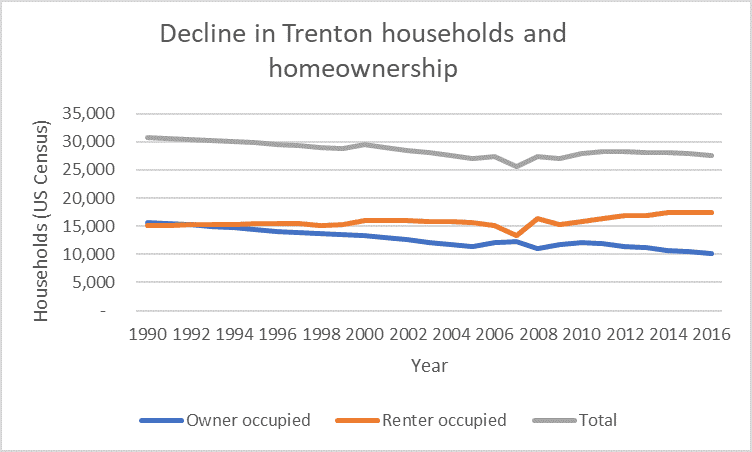
This picture should scare the living daylights out of anyone who owns a home in Trenton. It’s very possible that you may be the only one left to turn out the lights when Trenton closes.
Most people would say home-ownership is good for a city and its residents. I have no reason to dispute that. It only makes sense that a homeowner would be more vested in the state of their home, the cleanliness of the area around them and the future of the city.
This idea is borne out by research conducted by J. Eric Oliver in his book Local Elections and the Small-Scale Democracy. Mr. Oliver found that homeowners voted in almost double the proportion than did renters. Let me say it again, homeowners vote at double the rate of renters. According to his statistics, 70% of homeowners will regularly vote while only 40% of renters cast a ballot. This makes sense as the value of a homeowner’s largest investment is directly tied to the fortunes of a city.
Trenton politicians run against this trend.
None of the 2018 Trenton Mayoral candidates have established a strong position on how to make Trenton attractive for homeownership. This, despite the overwhelming evidence that homeowners vote in big numbers. The results shown in the above graph bear this trend out and suggest that previous candidates and Mayors have given scant attention to owner-occupied neighborhoods like Hiltonia, Hillcrest, Mill Hill and Franklin Park. They’ve been oblivious as Chambersburg and South Trenton have become predominantly rental.Trenton has steadily become less attractive to homeowners during the Palmer, Mack and Jackson tenures. It seems counterintuitive that this would have happened.
Mr. Oliver’s book suggests an answer to this puzzle. His research analyzed positions taken by candidates and the factors that drive them in small cities arranged by three characteristics of the city: size, scope and bias. Size is self-explanatory. Trenton is on the big side of small cities (< 100,000 in population). Scope is the range of services the city provides. Some cities may rely on county or states to provide services. Some outsource services. Trenton has a large scope in that most of our services are provided directly by the City of Trenton (water, police, etc.). One notable exception in Trenton is that the school system is quasi-independent. Bias is how uniformly resources are distributed and is probably the most important characteristic to consider for Trenton.
Bias happens when special interests or political machines can unevenly distribute resources to their own constituents. In other words, they redistribute the winner’s spoils. Mr. Oliver gives a New Jersey example in his book that I found illustrative.
“As an example, consider the political importance of a garbage contract for a rich township like Princeton, New Jersey, compared to its impoverished neighbor Camden. With a median family income above $125,000 a year and an average home value of over $1 million, it is highly unlikely that many of Princeton’s 16,000 residents work for garbage companies (although they may own one). When the township hires a garbage company, it is probably importing all its labor and services. On the other hand, a garbage contract for an impoverished place like Camden (with an unemployment rate well over 30 percent) means dozens of good jobs for its residents. When Camden hires a garbage company, its leaders will thus be under considerable political pressure to hire Camden residents and to employ a locally operated firm. Camden officials who decide the garbage contract will, in turn, probably expect continued support from the company and its workers. The garbage contract, simply by virtue of Camden’s poverty, will be a major source of political contestation whereas in Princeton it is simply a contract to be filled.”
Oliver, J. Eric. Local Elections and the Politics of Small-Scale Democracy (Kindle Locations 661-669). Princeton University Press. Kindle Edition.
Does that sound familiar? It should. You can’t talk about a project in Trenton where someone with an interest in city employment won’t make that argument. Our Mayor and City Council generally consider whether a contractor will employ city residents and therefore de-prioritize the importance of cost and service. When they do this, they de-prioritize the interests of home owning taxpayers.
Size matters because voters in a larger city like Trenton are more disengaged than in a smaller city like Hopewell as voters are less personally connected to office seekers, according to Mr. Oliver. Scope matters because a larger city has a lot of money to throw around. But bias is also a factor as it provides the reason why homeowners can be left out of the political calculus. In Trenton, homeowners are ignored because a Mayor and City Council can become beholden to special interests (city service providers, affordable housing developers, and labor unions, etc.)) that feed off of bias in our city government. The problem is made bigger by our large scope and is enabled by the relative size of the city and disengagement of its voters.
Is there a way out for Trenton?
Yes. Let me explain.
If you’re a homeowner in Trenton, then you must know that we are more Camden than Princeton in that special interests not aligned with your own are hard at work. While all you really want are low property taxes and a high level of city services, including water, police, schools and public works, others don’t share your concern. It’s natural.
However, even though the ranks of homeownership in Trenton have been decimated, they still vote in higher proportions than renters. Voting still matters though candidates can and do certainly still lie to us about their vested interests (i.e. who’s funding them now and in the future).
For a candidate to be believable as a pro-homeowner candidate then their platform, fundraising and speeches need to put homeownership front and center. Making Trenton attractive for residential investment must be their only “focus”. They must stand out as the “homeowner” candidate.
This means trimming non-essential services that don’t directly benefit homeowners. It means investing more in making it easier to develop and improve property. It means increased school choice. It means more responsive police and public works departments. It means new economic development. And, most of all, it means that there is a plan for the tax rate to eventually go down. Trenton’s tax rate is the highest in Mercer County and as high as a mortgage rate.
This is hardcore stuff, but Trenton is in decline and has been for some time. We are losing population. Our per household income is losing ground vs. the rest of the state. And obviously homeowners are leaving.
Voters will have to understand that they have a very real threat if we continue to elect politicians who can’t or won’t address the issues of homeowners, they will likely never recoup the investment in their houses and the situation will only get worse. Taxes will continue to rise as property values decline or stay stagnant. Services will continue to deteriorate until we hit rock bottom and look even more like Camden or Detroit.
It’s hard to say whether our decline is already too severe to recover from without an existential catastrophe like Detroit’s bankruptcy or Camden’s worst in the nation murder rate. However, not trying to elect leadership with a real focus on reversing the homeownership trend just isn’t an option.
Posted in Trenton Elections |
Tags: home ownership decline, households, NJ, rental, Trenton |
No Comments »